Until I Know Better
1. Motivation & Background
I find myself in a dilemma. One which I can’t seem to shake off that easily. Whenever presented with a new piece of information, how much should I allow it to change what I already believe in? Keep oscillating between extremes frequently and I doubt myself to be too fickle-minded, someone who is swayed easily. Decide to stay put on my stance despite, and I wonder whether I am too stubborn in my way of living.
Let me acknowledge the nuance here right away. I know I should be considering this on a case-to-case basis, based on the specific belief and also the new piece of information. However, I want to take this a level deeper. I want to align my intuition to aid me in the process of updating my beliefs. I want to develop an internalised sense of what it means to (re)consider our beliefs in the light of new evidence. What exactly should be going on in my mind as I am learning something new about something that I already had some background on?
After all, I want to base my beliefs on something which is closer to truth, and not just on what I have been believing in all my life, or what I heard a random passerby say. As perplexing as it may sound but there is a subtle difference between “truth” and the “belief” that we have found the truth.
By the end of this article, I hope to become better at navigating the fine line between conviction as a virtue and conviction as the very thing keeping me trapped in my own deluded realities.
2. Degrees of Belief
One of the fundamental disconnects I have is when I see people fail to acknowledge nuances in any debate, discourse or discussion. I have trouble relating with the fact that all agreements and disagreements should be absolute positions, as though we must either believe something wholeheartedly or reject it entirely. “No, tell me, ‘yes’ or ‘no’“. It is often useful to think of belief in percentages instead.
I encourage you to participate in the following illustrative. Spend a few seconds between each successive evidence and move the slider as per intuition:
Notice how your belief has evolved over the course of evidences you got. The point to be driven home here is that unlike truth, which is generally binary (i.e. true/false) in nature, our confidence that we’ve identified the truth isn’t necessarily binary.
With the non-binary nature of beliefs established, the usefulness of this perspective is criminally underrated! Effectively, whenever we encounter new evidence, we can use it to update our degrees of belief, hopefully bringing us closer to the truth.
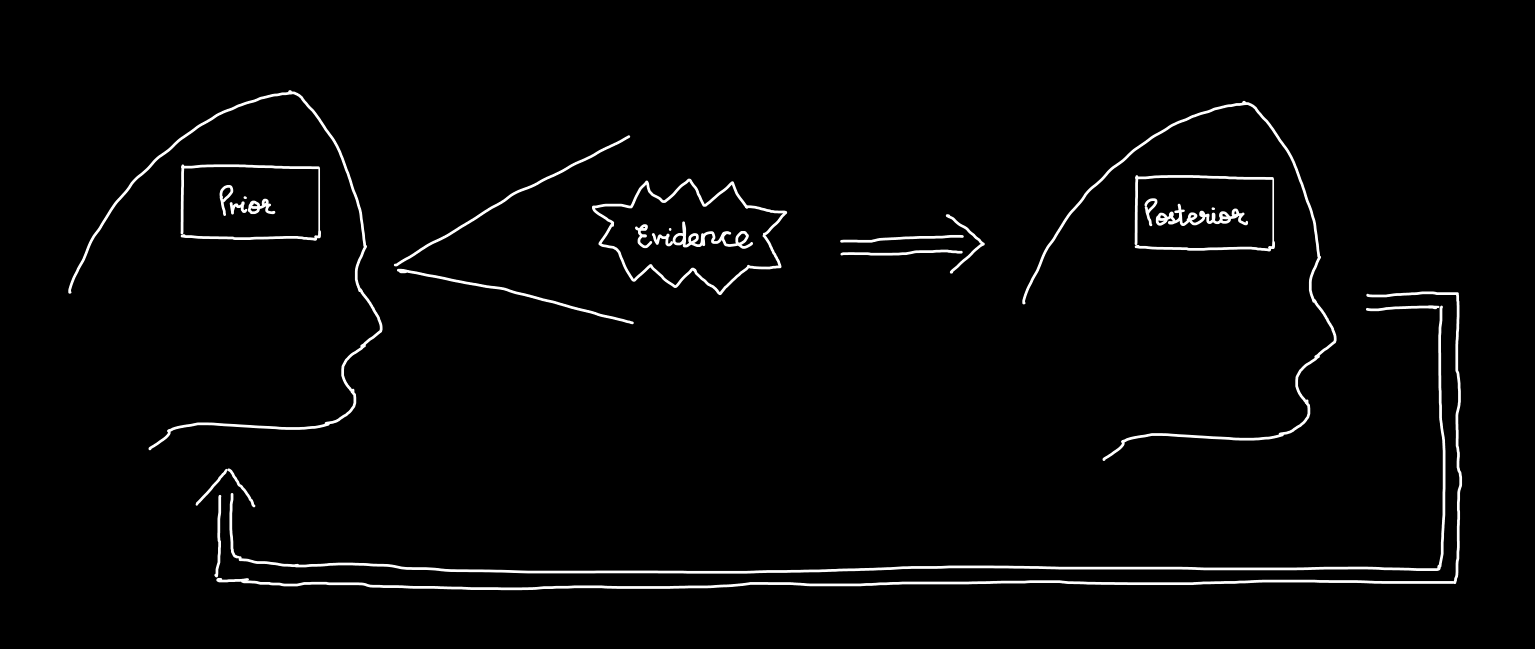
Every observation you make should be nothing but an update then. You held a prior belief, you observed an evidence for/against it, you revised the confidence you already had, based on the new observation to obtain a posterior belief.
Take a moment to appreciate what you are noticing here. Almost every single time, we never update our belief just based on the evidence we see. There is a prior belief influencing it too. Introducing just a tinge of formality here:
Notice how a same evidence can have differing impacts on people having different prior beliefs. I highly recommend the movie 12 Angry Men. The movie is a personal favorite and expresses this idea beautifully.
This way of reasoning is also called Bayesian reasoning. I don’t intend to go into the maths behind it, however for my nerdy math readers, LessWrong’s Arbital Guide is something worth looking into if this way of thinking has resonated with you.
3. Not all Evidence is created Equal
Observe another interesting behavior here. As new evidences show up above, you do not merely move the slider by same amount every time. Some observations make you reconsider your beliefs much more drastically than others. So what exactly governs the strength of an evidence here? What makes you move the slider further away? Clearly we seem to possess an innate understanding for the same. Considering the spirit of this article however, time to dig deeper into this intuition.
A strong evidence is something we would be much more likely to observe if the claim were true than if it were false. Put differently, exclusivity is one of the stronger indicators of strength of evidence. “Sure, the evidence is mostly the explanation for the claim you are making, but does the absense of the claim also imply lack of evidence?“.
The latter half of the previous sentence is often overlooked. It is difficult to comprehend after all. We often seem to believe claims based on weak evidences much more easily than we ought to. One of the best examples of this is believing in the supernatural.
Consider a small family who shifts into an old abandoned house down the street. They claim to hear footsteps from the attic late at night. If your intuition jumped to “GHOSTS!”, hold on, old wooden floors creak, pipes make strange noises, and sounds can travel in unexpected ways. There are several perfectly natural explanations for what they’ve just experienced. Sure, a ghost might explain the footsteps, but so could a dozen other things.
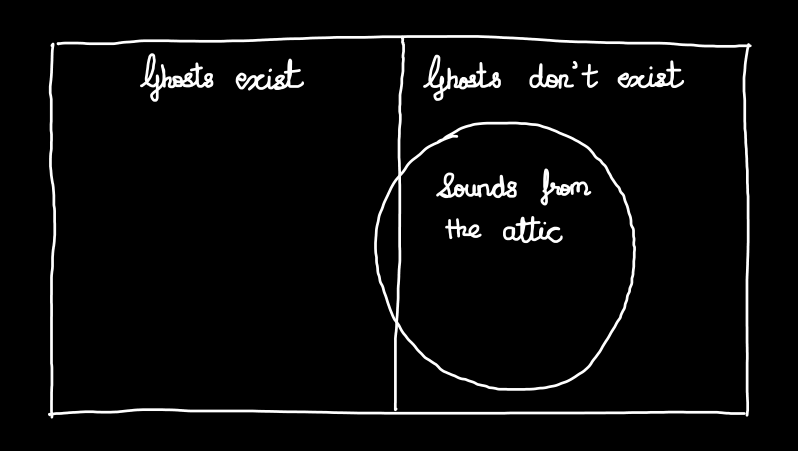
To avoid falling for such a fallacy, always ask yourself whether there are any alternate explanations to your current hypothesis/observation and how likely are they to occur. The biggest gotcha here is that multiple different causes can produce the same effect. So take a step back the next time you see yourself endorsing one and only one explanation for an obscure observation.
I’ve found the following heuristic a whole lot useful to estimate the strength of evidence, or Likelihood ratio (source):
Just looking at the evidence given the claim is not enough. We need to look at the evidence when the claim would be false too! Because if the evidence is equally likely in both cases, then it does not eliminate possibilities for us at all! For a evidence to be strong, we need it to be true only when claim is true (the numerator) and we need it to be as low as possible when the claim is false (i.e. consider an absurd world where only Ghosts made sounds and nothing else!).
So now we have an intuition for what makes evidence strong. But here’s another interesting question: how strong does the evidence need to be for us to actually believe a claim? Surely, that must depend on how believable the claim was to begin with?
4. (Extra-)ordinary claims require (extra-)ordinary evidences
Recall from the second section how our posterior belief doesn’t just depend on the evidence, that’s just one half of the equation. It depends on the prior belief too!
Now, the further away you are from the center of the belief spectrum, the stronger the evidence is needed for you to be convinced otherwise. And if you seem to believe in something with all your life, nothing short of an extra-ordinary evidence would be required for you to stop believing in the same.
No wonder as we grow old it becomes harder for us to uproot our existing beliefs. We have piled up evidences after all. But as long as there exists a stronger evidence, we should always be open to considering moving our position on the belief spectrum. Put differently: Extra-ordinary claims require extra-ordinary evidences.
We have a basic understanding of what “extra-ordinary” evidences are. What about “extra-ordinary” claims? This may be a deep topic of its own to cover, however roughly speaking, a lot of it depends on your existing world views and world models in general. An extraordinary claim is essentially a claim that is very unlikely given our existing knowledge of the world.
Remember, the idea is that ordinary evidences should not make you update your beliefs drastically. That doesn’t mean that you should discount ordinary evidences entirely! It is perfectly fine to say: “yes, that is evidence in favor of the claim, but it’s not quantitatively enough evidence”. Enough ordinary evidences can compound rapidly to form an extra-ordinarily strong thesis for you to reconsider your stance, compared to say dismissing each observation as ‘insufficient evidence’ and then forgetting it.
There is an (arguably more) important corollary here: Ordinary claims only require ordinary evidences. We generally do not need to seek extra-ordinary evidences for something that is generally expected. This one is especially relevant for the chronic over-thinkers.
A typical example can be seen in sports. A star player has a few disappointing games, and suddenly everyone has an explanation. “It’s the coach! It’s the new environment! No, it’s the lifestyle!” While any of those explanations might be true, perhaps the player just had a bad run of games. Even the greatest players have ordinary, unremarkable performances from time to time. We don’t always need an elaborate explanation for something that was perfectly plausible to begin with!
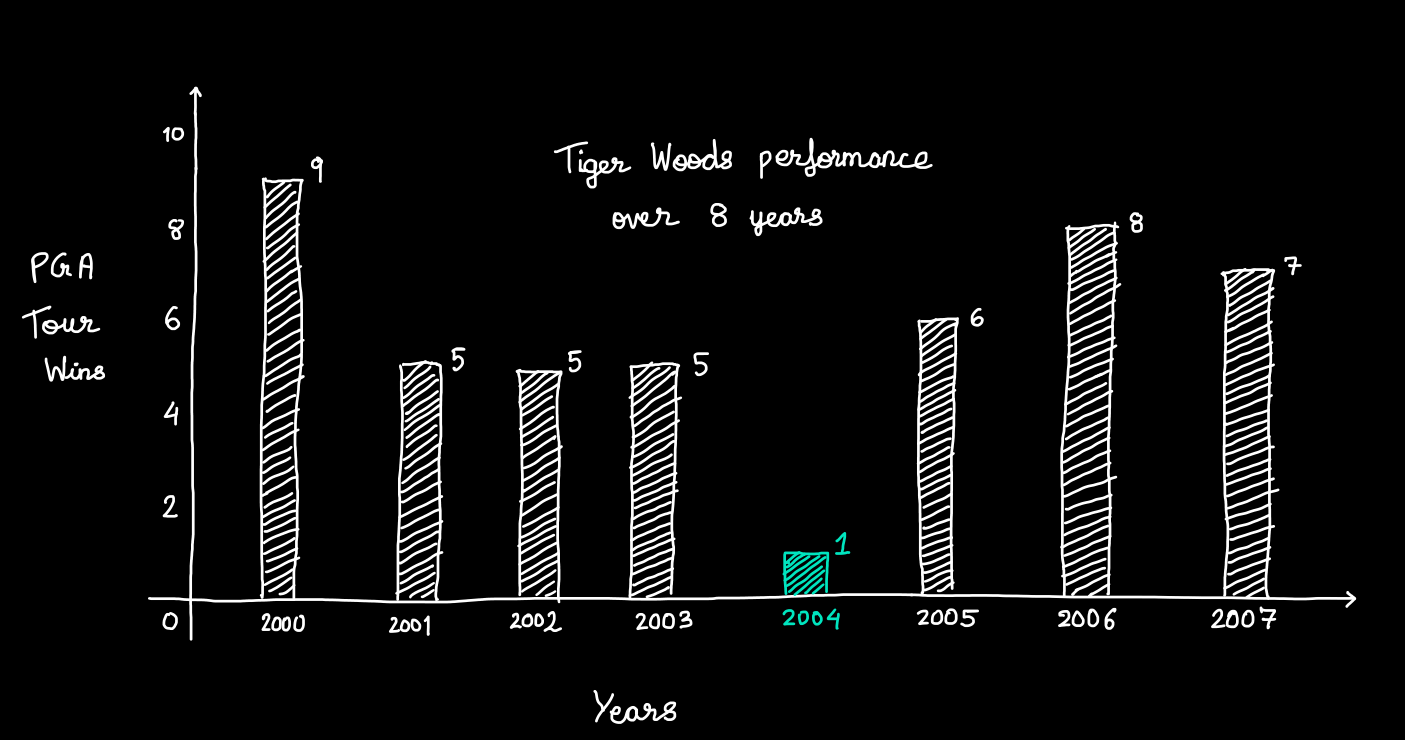
The goal, after all, isn’t to doubt everything. It’s to doubt things only as much as we have reason to. If all this sounds like an argument in favor of stubbornness, well, it’s time to turn the tables.
5. The Ends of the Spectrum
For any belief, it is interesting to be on either end of the belief spectrum. This is the “Yes” or “No” category that I criticised in the previous sections. My critism is because both of these states are the states of permanency. By assigning absolute certainty, we are effectively declaring that no future evidence could ever change our minds. Consider how strong of an evidence would be required to push our degrees of belief to either end of the extreme! (Spoiler: It is infinity).
At 100% degree of belief you know for a fact that a certain claim is true. At such a state how are you supposed to respond to any contradictory evidence? You had attained perfect information yet somehow failed to account for one of the evidences? At that point, you simply have to disregard the piece of evidence. This goes exactly against the principles of Bayesian updates.
As Rafal Smigrodski put it, “I am not totally sure I have to be always unsure. Maybe I could be legitimately sure about something. But once I assign a probability of 1 to a proposition, I can never undo it. No matter what I see or learn, I have to reject everything that disagrees with the axiom. I don’t like the idea of not being able to change my mind, ever.”
Being at 0% belief is even more interesting and easy to argue against. In such a case you are absolutely sure that the claim is false. At this point, you will not be believing any evidence you see for the claim (Anything times zero is still zero). Now the next time you are in an argument with someone and they mention to you that no amount of convincing is going to convince them, you have a good place to start (or end!).
Put this way, you almost never want to assign probabilities 0% or 100% to anything. This rule is referred to as Cromwell’s Rule. And if this isn’t an argument against being stubborn then I am not sure what is.
If you’re wondering whether we’re taking this a little too seriously, consider how Dennis Lindley, the statistician who named Cromwell’s rule, put it: “leave a little probability for the moon being made of green cheese; it can be as small as 1 in a million, but have it there since otherwise an army of astronauts returning with samples of the said cheese will leave you unmoved”.
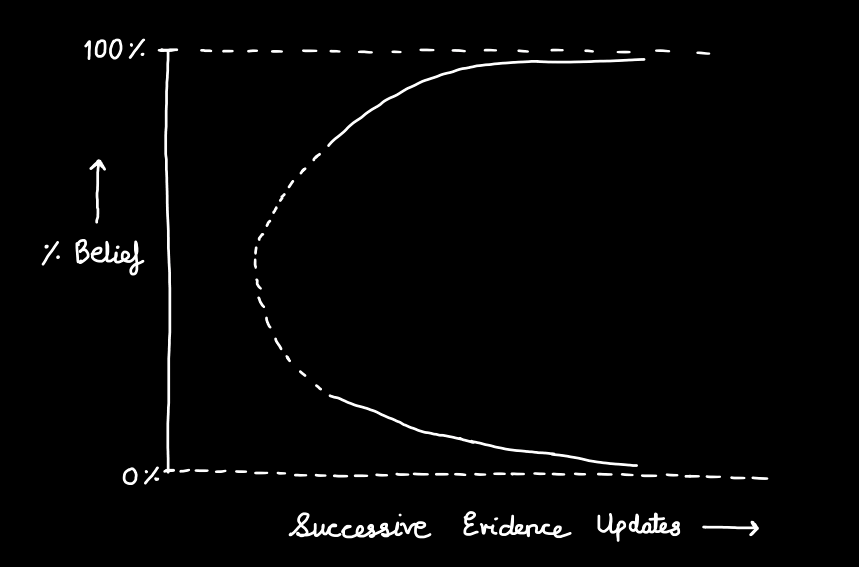
There’s something almost paradoxical about all this. But perhaps that’s precisely where the answer to my original dilemma lies.
6. The Heart of the Contradiction
If I have done my job well, by now you must be slightly confused with this as well. On one hand, I’ve argued that we should hold firmly to beliefs supported by strong evidence, and resist changing them without sufficient reason. On the other, I’ve argued that we should never become so certain of our beliefs that we close ourselves off to the possibility of being wrong. This is the true contradiction that haunts me.
Note: I purposely reference myself and use “I” for the next few paragraphs. I have a strong hunch that I will keep revisiting this section of this article time and time again. I want the author of this essay to be there for when future me inevitably forgets parts of my research for this article.
To begin with, I do not wish to say that I should not have conviction or that I should hold my beliefs loosely. In fact, I’d argue I should have strong opinions about everything I care about! I want to set an inductive precedence towards belief systems. It is important to have beliefs whose strength reflects the available evidence (and can change as the same evidences change). Qualified Conviction is almost certainly a virtue.
Another philosophy to gracefully embrace is Intellectual Humility. No matter how intelligent, experienced, or informed I am, I can be mistaken. I should never confuse confidence with infallibility. Sometimes that means abandoning a belief I’ve held for ten years. Sometimes it means confidently defending a belief despite ten people disagreeing with me. What matters is the quality of the evidence, not merely the number of people agreeing or disagreeing with me.
An extension to the previous realisation is also that I endorse Receptive Skepticism. I want to give every person a fair chance to make their claim. I want to be willing to investigate whether they know something I don’t. At the same time, I do not want to mistake every objection as “good” evidence. I do not want to merely tolerate disagreement. I want to engage more in well-informed dissent.
As I was meditating deeply on this topic to prepare for this essay, is when I start to realise that the purpose of questioning beliefs isn’t always to weaken conviction; It is in fact to ensure that my convictions deserve the confidence I keep placing in them. The very act of questioning is what increases my confidence on my beliefs or, it makes me revise them, either ways I am better off questioning.
There is something paradoxical about this philosophy. I can be deeply committed to seeking the truth but only provisionally committed to any particular understanding of it.
There is no merit to staying loyal to my beliefs. I need to be loyal to the “process” of discovering what’s true.



;%20}%20.cls-2%20{%20fill:%20%23fff;%20}%20%3c/style%3e%3cradialGradient%20id='radial-gradient'%20cx='48.46'%20cy='-.95'%20fx='48.46'%20fy='-.95'%20r='64.84'%20gradientUnits='userSpaceOnUse'%3e%3cstop%20offset='0'%20stop-color='%239f42c6'/%3e%3cstop%20offset='.27'%20stop-color='%23a041c3'/%3e%3cstop%20offset='.42'%20stop-color='%23a43ebb'/%3e%3cstop%20offset='.53'%20stop-color='%23aa39ad'/%3e%3cstop%20offset='.64'%20stop-color='%23b4339a'/%3e%3cstop%20offset='.73'%20stop-color='%23c02b81'/%3e%3cstop%20offset='.82'%20stop-color='%23cf2061'/%3e%3cstop%20offset='.9'%20stop-color='%23e1143c'/%3e%3cstop%20offset='.97'%20stop-color='%23f50613'/%3e%3cstop%20offset='1'%20stop-color='red'/%3e%3c/radialGradient%3e%3c/defs%3e%3cg%20id='_x2D_-production'%3e%3cg%20id='logomark.square.gradient'%3e%3cpath%20id='background'%20class='cls-1'%20d='M48,11.26v25.47c0,6.22-5.05,11.27-11.27,11.27H11.26c-6.22,0-11.26-5.05-11.26-11.27V11.26C0,5.04,5.04,0,11.26,0h25.47c3.32,0,6.3,1.43,8.37,3.72.47.52.89,1.08,1.25,1.68.18.29.34.59.5.89.33.68.6,1.39.79,2.14.1.37.18.76.23,1.15.09.54.13,1.11.13,1.68Z'/%3e%3cg%20id='checkbox'%3e%3cpath%20class='cls-2'%20d='M13.62,17.97l7.92,7.92,1.47-1.47-7.92-7.92-1.47,1.47ZM28.01,32.37l1.47-1.46-2.16-2.16,20.32-20.32c-.19-.75-.46-1.46-.79-2.14l-22.46,22.46,3.62,3.62ZM12.92,18.67l-1.46,1.46,14.4,14.4,1.46-1.47-4.32-4.31L46.35,5.4c-.36-.6-.78-1.16-1.25-1.68l-23.56,23.56-8.62-8.61ZM47.87,9.58l-19.17,19.17,1.47,1.46,17.83-17.83v-1.12c0-.57-.04-1.14-.13-1.68ZM25.16,22.27l-7.92-7.92-1.47,1.47,7.92,7.92,1.47-1.47ZM41.32,35.12c0,3.42-2.78,6.2-6.2,6.2H12.88c-3.42,0-6.2-2.78-6.2-6.2V12.88c0-3.42,2.78-6.21,6.2-6.21h20.78v-2.07H12.88c-4.56,0-8.28,3.71-8.28,8.28v22.24c0,4.56,3.71,8.28,8.28,8.28h22.24c4.56,0,8.28-3.71,8.28-8.28v-3.51h-2.07v3.51Z'/%3e%3c/g%3e%3c/g%3e%3c/g%3e%3c/svg%3e)